
More than a third of online shoppers in the European Union experienced one or more problems last year. Late delivery is mentioned most often as an obstacle. In five member states, more than half of online shoppers reported issues.
This emerges from a Eurostat release that compiles figures for individual countries. On average, 35.4 percent of regular online shoppers in the EU encountered an issue last year. In 2023, when this topic was last measured, the share was 33.1 percent. At that time, only two countries recorded a share above 50 percent: Luxembourg (56 percent) and the Netherlands (55 percent).
Most problems in Malta
Two years later, five countries recorded shares above 50 percent, according to the latest data on ecommerce in Europe. These are leader Malta (64 percent), the Netherlands (58 percent), Luxembourg (51 percent), Hungary (also 51 percent) and Spain (50 percent). Norway, which is not a member of the EU, records an even higher share at 67 percent.
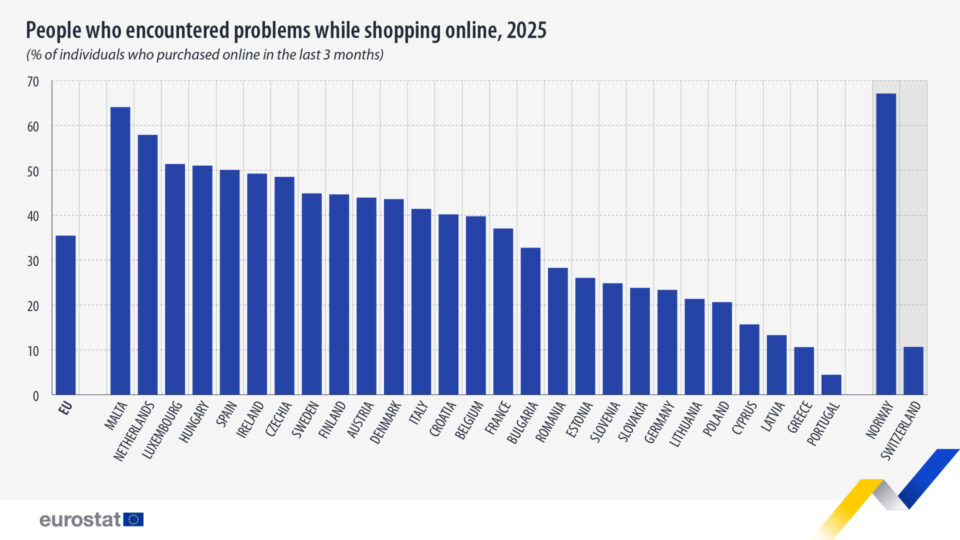
Online shoppers in mature ecommerce markets do not appear to experience fewer problems than consumers in countries where online shopping is still developing. The opposite may even be the case, which could be related to expectations or the number of online purchases in markets. The lowest shares of customers encountering problems were reported in Portugal (5 percent), Greece (11 percent) and Latvia (13 percent).
Portugal recorded the fewest problems
Types of problems
Eurostat also reports which types of problems occur most often among online shoppers. The most common issue was slower delivery than expected, reported by one in five customers (20 percent).
One in five shoppers experienced late delivery
Other frequently mentioned problems are websites that are too complicated or do not function properly (12 percent). The third most common issue was delivery of incorrect or damaged goods or services, reported by more than 10 percent of customers.

Online shoppers in Europe
Other new Eurostat figures show that 78 percent of EU citizens bought something online in 2025. Several million new online shoppers were added last year. Adoption has grown particularly strongly in recent years in Eastern Europe.
Source link